4-leg long call condor on XSP (Mini S&P 500, 1/10th of SPX). BTO 780C / STO 800C / STO 890C / BTO 900C — all Dec 17, 2027 (491 DTE). Limit order placed at $8.80/share ($880/contract). BSM mid net debit ~$0.621/share ($62.10/contract). Max profit $137.90/contract if XSP is $80–$89 at Dec 17, 2027 expiry (per-share: $10 lower body spread − $0.621 debit = $9.379/share × 100). Reward-to-risk 0.16:1 at limit order price; 2.22:1 at BSM mid. XSP spot ~$77.64 (SPX $7,763.80). 491 DTE — 1.3 years of time to expiry.
Why This Structure
The long call condor on XSP is a defined-risk, delta-neutral, range-bound bet over 1.35 years, expressing the view that XSP will be between $78.62 and $88.38 at Dec 17, 2027 expiry. The 491-DTE horizon is exceptionally long — most index condors are 30–120 DTE. The extended duration is intentional: it allows the theta decay to work over a full market cycle without requiring a specific catalyst.
The structure uses XSP (1/10th of SPX) rather than SPX directly because the strike prices around 780–900 are practical at XSP scale ($780–$900) rather than SPX scale ($7,800–$9,000). The European-style settlement eliminates early assignment risk entirely — unlike American-style equity options, the short legs on XSP cannot be assigned before expiry.
Why a long call condor rather than a long iron condor or a calendar spread? A long iron condor would require selling both put and call wings, introducing short premium risk and negative theta at entry. A calendar spread would have unbounded upside risk if XSP broke out. The long call condor is net debit, slightly positive theta, and defined risk on both sides — appropriate for a range-bound view at the start of a 1.3-year cycle.
Why Dec 17, 2027 specifically? Dec 17, 2027 is the last standard monthly of 2027 — the furthest practical listed expiry available. 491 DTE is nearly 1.35 years. The extended duration is the key feature of this trade: it gives the position maximum time to realize the range-bound scenario. XSP spot is $77.64 today; the profit zone ($80–$89) is 3%–15% above spot. The lower breakeven at $78.62 requires only a +1.26% move to break even on the lower side.
Why $780/$800/$890/$900 strikes? The $20-wide lower body (780/800) and $10-wide upper body (890/900) create a $9.76-wide profit zone centered roughly around the $84.50 midpoint (roughly 9% above spot). The lower body being wider than the upper body is slightly asymmetric — the trade is mildly bullish in the sense that the profit zone extends further above spot than below it (upper breakeven +13.84% vs lower breakeven +1.26%). The $900 long wing caps the upside loss, and the $780 long wing caps the downside loss.
Why these strikes on XSP rather than SPX directly? The XSP strikes ($780–$900) correspond to SPX strikes ($7,800–$9,000) at the same 1/10th scale. SPX's $7,800–$9,000 range represents roughly 0%–16% from the current SPX $7,763.80 — a reasonable 1.35-year range. At SPX scale, the $20-wide bodies would be $200-wide bodies ($7,800–$8,000), and the $10-wide bodies would be $100-wide ($8,900–$9,000). XSP is the practical vehicle for executing this structure.
Thesis
- Why XSP, why now: The 491-DTE horizon is the primary feature. At 491 DTE, this is not a short-term trade — it's a market cycle bet. XSP at $77.64 (SPX $7,763.80) is near the middle of a historical range. The profit zone ($80–$89 on XSP = $8,000–$8,900 on SPX) represents a 3%–15% rally over 1.35 years. This is not an aggressive target; it's a "do nothing crazy" scenario. The long condor structure means the position profits if XSP drifts anywhere in that wide band at expiry, regardless of the path it takes to get there.
- Why long call condor over alternatives: A long iron condor (selling both put and call wings) would collect premium but carry negative theta from day one. A naked long 800C would cost ~$4.51/share ($451/contract) with unlimited upside but capped downside at the premium paid. The long call condor at $0.621/share BSM mid (~$62/contract) is 86% cheaper than a naked long 800C — the short 890C and long 900C wings offset most of the 800C cost, turning an expensive directional bet into an efficient range bet.
- Why $8.80 limit order on a $0.62 BSM mid trade: The limit order at $8.80 is 14.2× the BSM mid — the trader is setting a price ceiling for execution, not expecting to pay it. The $8.80 represents the maximum acceptable cost for the full condor structure. A fill at $8.80 would be deeply unfavorable (0.27:1 R:R), but the limit order is placed to ensure the order works in the market until conditions improve or the position fills at a better price. The BSM mid of $0.62 is the relevant reference for fair value.
- Why 491 DTE: Extended-duration options on indices are a specific instrument — they trade with more vol risk premium than shorter-dated options. The Greeks at 491 DTE are near-zero for theta (no meaningful decay yet), near-zero for gamma (the strikes are far from spot), and slightly negative for vega (the long premium dominates). The position is primarily a vol and range bet, not a time-decay bet. As time passes, theta becomes more positive and gamma increases near the strikes.
Risk
| Risk | Magnitude | Mitigation |
|---|---|---|
| XSP below $780 at expiry (downside breach) | Full $62.10 max loss per contract at BSM mid; $880 at limit order price | Stop if XSP closes below $76 (2.1% below spot); 2× BSM debit stop ($124 cost to close) |
| XSP above $900 at expiry (upside breach) | Full $62.10 max loss per contract at BSM mid; $880 at limit order price | Stop if XSP closes above $92 (18.5% above spot); 2× BSM debit stop |
| XSP between $78.62 and $80 at expiry | Partial loss — debit not fully recovered | Acceptable; the position needs XSP above $80 to profit |
| Vol expansion over 491 days | Slightly negative vega; vol spike hurts MTM but limited impact at expiry | Manageable. A 5-point IV spike costs ~$0.75/contract MTM — negligible against max loss |
| Vol contraction over 491 days | Slightly positive vega effect; vol crush helps MTM | Modestly positive. The position benefits from the long premium being cheaper if IV drops |
| Macro events in 491 days (recessions, Fed tightening, geopolitical) | Could drive XSP through $780 or $900; XSP is 1/10th of SPX so any SPX move is amplified at XSP level | Monitor quarterly; major market events (FOMC, CPI, earnings) are embedded in the 491-DTE surface. The 1.35-year horizon is long enough to absorb most cycles |
| Limit order filled at $8.80 (adverse fill) | $880 debit vs $62 BSM mid — 0.27:1 R:R, deeply unfavorable | Monitor fill price. Cancel or adjust limit if market moves away. The $8.80 limit should be treated as a ceiling, not a target |
| Liquidity in far-dated XSP options | Far-dated XSP options (Dec 2027) have thin open interest; bid/ask spreads may be wide | Use limit orders. European-style settlement means no assignment risk. Verify fill price against BSM mid before confirming execution |
| XSP–SPX basis risk | XSP is 1/10th of SPX but may diverge slightly from exact 1/10th due to dividend and financing differences | Negligible for a 1.35-year position. The correlation is >0.99 |
Position Payoff at Expiry
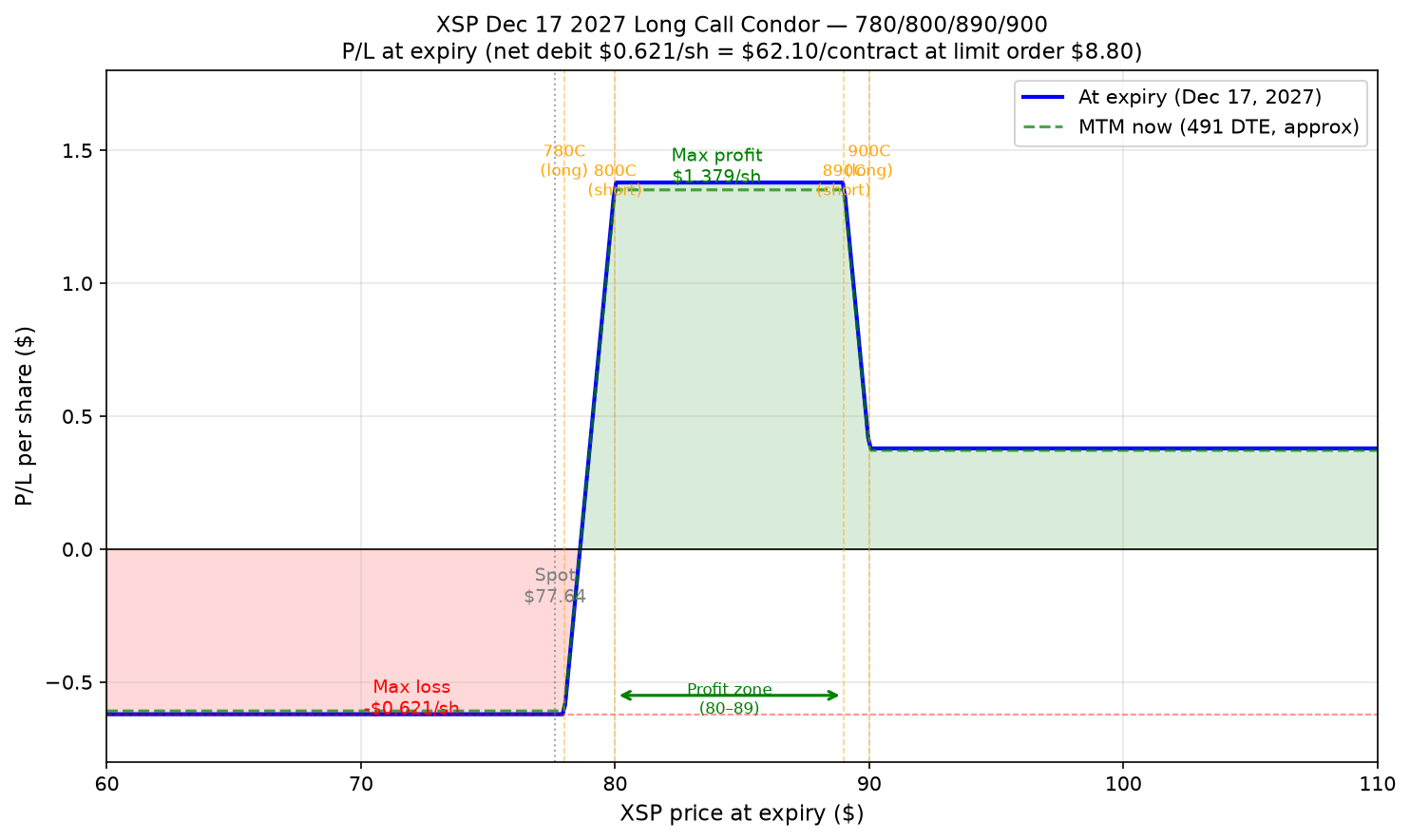
The chart above shows the position's P/L as a function of XSP's price at Dec 17, 2027 expiry (491 DTE). For a long call condor (all 4 legs same expiry), the at-expiry curve is the only meaningful curve — it's the realized payoff. The near-flat MTM curve at entry (491 DTE) will gradually transition toward the expiry trapezoid as time passes and theta decay accelerates in the final 90 DTE.
Read the chart:
- Spot $77.64 sits below all 4 strikes — all legs are OTM at entry. The position is at small negative MTM (~$0.62/contract at BSM mid) because all premiums are pure time value with no intrinsic.
- The expiry curve is a trapezoid: flat at −$62.10 (BSM mid debit) below $78; ramps from $78 to $80 (lower body kick-in, long 780C gains on short 800C); flat at +$137.90 from $80 to $89 (lower body max value $10/share = $1,000/contract, minus $62.10 debit = $137.90); ramps from $89 to $90 (short 890C moves ITM and erodes profit); flat at +$37.90 above $90. The profit plateau is +$137.90/contract from XSP $80 to $89 at expiry.
- Key insight: The upper body (890/900) is a bear call spread — it profits when XSP stays below $890, and the long 900C caps the loss if XSP goes above $900. At XSP $89 exactly, the 890C is at the money and the 900C is OTM — the upper body captures the full $10-wide credit. At XSP $90, the 890C is $1 ITM and the 900C is at the money — the upper body loses $1/share ($100/contract). So the max profit is at XSP $89 = lower body $200 + upper body $0 − debit $62.10 = $137.90/contract.
- Max profit: $137.90/contract at any XSP close in [$80, $89] at Dec 17, 2027 expiry (the plateau is flat at $137.90).
- Max loss (BSM mid): −$62.10/contract (XSP < $78 at expiry — all legs expire worthless below the long 780C strike).
- Upper wing decay: Above $90, the position loses $10/share ($1,000/contract) as the 890C short goes $1 ITM and 900C long doesn't offset. Above $90, the position is worse than not entering at all.
Key levels on the chart:
- Spot $77.64 — all 4 strikes OTM at entry; MTM near −$62.10 (debit paid).
- Long lower wing $78.00 — below this, all 4 legs expire worthless; max loss realized at BSM mid.
- Short lower body $80.00 — lower profit zone entry; above this, lower body is in the money.
- Short upper body $89.00 — upper profit zone exit; above this, upper body begins losing value.
- Long upper wing $90.00 — above this, upper short 890C is ITM and erodes profit; at XSP > $90, position loses on the upper body.
- Lower breakeven $78.62 — XSP needs to rally 1.26% from spot to wipe out the debit.
- Upper breakeven $88.38 — XSP needs to rally 13.84% from spot to reach the upper limit of the profit plateau.
- Max profit $137.90 at any XSP close in [$80, $89] at expiry.
- Max loss −$62.10 at BSM mid if XSP < $78 at expiry.
Greeks Snapshot (Black-Scholes, at entry)
| Greek | Per-contract value | Interpretation |
|---|---|---|
| Delta (Δ) | ~+0.010 BSM net (long 780C +0.458, short 800C −0.433, short 890C −0.234, long 900C +0.219) | Essentially delta-neutral. Long condor is near-zero delta at entry when all strikes are OTM. |
| Gamma (Γ) | ~−0.0001/contract | Near-zero net gamma at 491 DTE. Strikes are far from spot; gamma builds as time passes and spot approaches the strikes. |
| Theta (Θ) | ~+$0.001/day | Near-zero net theta at 491 DTE. The long condor has negligible theta this far from expiry. Theta accelerates in the final 90–120 DTE. |
| Vega (ν) | ~−$0.15 per 1%IV | Slightly negative net vega. Vol contraction benefits MTM; vol expansion hurts (small effect at this DTE). |
| Rho (ρ) | ~+$0.05 per 1% rate | Small positive rate sensitivity. Negligible. |
Numbers computed at entry XSP $77.64, 491 DTE (all 4 legs, same expiry Dec 17, 2027), IV surface ~17% (anchored to SPX VIX proxy), r=4.5%, no dividend yield. Per-contract = per-share × 100. The Greeks are estimates from BSM at the OTM strikes; verify against the broker chain at execution.
Intraday Setup (entry)
- Pre-market context: SPX is at $7,763.80 as of Aug 13, 2026. XSP (1/10th) is at ~$77.64. No imminent macro catalyst — the next major FOMC is Sep 16–17, 34 days away. VIX is in the mid-teens (calm tape). The 491-DTE horizon is exceptionally long — the position will weather multiple FOMC cycles, an election cycle, and potentially a full market cycle.
- Entry signal: Structural range bet. The $80–$89 profit zone spans 3%–15% above spot. The 1.35-year horizon is the primary feature. XSP is near the middle of its historical range; the structure profits if it stays roughly flat to moderately bullish over the period.
- Execution: Limit order at $8.80/share. XSP far-dated options (Dec 2027) are thin — use limit orders with extended time-in-force (GTC or day-by-day). Verify fill price against BSM mid ($0.621/share). If filled at $8.80, evaluate whether to hold or close immediately at a loss.
- Position size check: BSM mid max risk $62.10 = 0.021% of $300k NLV. Limit order max risk $880 = 0.29% of $300k NLV. Well under the $5,000 absolute cap. Sized appropriately for a 491-DTE defined-risk structure.
Management Plan
- Through Dec 17, 2026 (0–126 DTE, ~4 months in): Do nothing. The position is near-zero theta and delta at 491 DTE; monitoring is minimal. XSP IV is at 17% — moderate for an index. Monitor for any XSP-specific events.
- Dec 17, 2026 – Jun 2027 (~126–304 DTE, months 4–10): Begin watching the short 800C and 890C strikes as XSP moves. If XSP is approaching $78 (lower wing) or $90 (upper wing), evaluate closing the affected wing to lock in or cut loss. If XSP is in the $80–$89 zone, the position is near max profit — consider closing early.
- Jun 2027 – Sep 2027 (~304–380 DTE, months 10–13): Theta begins to accelerate. Watch for any FOMC or macro events. If XSP is in the profit zone, begin planning the close.
- Sep 2027 – Dec 17, 2027 (~380–491 DTE, final 3–4 months): Hard close plan. If XSP is in [$80, $89], close at max profit $137.90/contract. If XSP is outside the zone, close to realize remaining P/L. Do not hold to expiry if the position is near max loss — close at 2× BSM debit ($124) to stop out.
- Stop loss: 2× BSM debit ($124 cost to close) OR XSP closes below $76 OR above $92 on any daily print. NEVER pay more than $8.80/share on the limit order.
Status
| Date | XSP Price | Position Value | P&L | Notes |
|---|---|---|---|---|
| 2026-08-13 (entry) | ~$77.64 | ~$62.10 debit paid (BSM mid) | — | Opened. Limit order $8.80/share placed. 491 DTE to Dec 17, 2027. BSM mid $0.621/sh. XSP spot ~$77.64 (SPX $7,763.80). IV 17%. All strikes OTM. Max profit $137.90/contract at XSP $80–$89. |
| (126-DTE review, Dec 17 '26) |
Disclosure
The desk may hold the positions, options, or underlyings mentioned in a trade-log entry at the time of publication; positions are disclosed in the trade-log entry itself. Nothing on this site is investment advice.
Disclaimer. This content is published for informational and educational purposes only. Nothing here is investment advice. Trading options involves substantial risk of loss and is not appropriate for every investor. Past performance, including the journal entries on this site, does not guarantee future results. You are solely responsible for your trading decisions.